
December 15, 2025

What’s new with FABRIC?
An update from Paul Ruth, FABRIC Principal Investigator
We had a great time at SC25 last month. Those who attended received a sneak peek at a couple of exciting new features. We can now announce that FABIRC now has Nvidia Bluefield 3s you can use to offload computation to ARM processors in the NIC or access various accelerators in the card. If you are interested in Nvidia Bluefield 3 NICs or distributed storage volumes for your project, please request these services.
If you have ideas for getting more involved with FABRIC, whether by being featured in our FABRIC Webinar Series, presenting at the next KNIT workshop, or contributing to community initiatives, we’d love to hear from you.
Reach out to Chelsea Davis, Project Manager, at cdavis@renci.org, and she will connect you with the appropriate FABRIC team member.
In this newsletter, you’ll find information about…
- KNIT12 Registration Open & Travel Reimbursement Application Available
- Golden Stitch Award: Call for Nominations
- The next FABRIC webinar focused on FABRIC’s Q&A tool
- FABRIC Articles & use cases
- The November FABRIC webinar focused on Bluefield NICs recording
- Opportunities to collaborate with the FABRIC team
KNIT 12: Registration and Travel Reimbursement Application Open
April 14-17, 2026 | Honolulu, HI
We cordially invite you to join us for KNIT 12, the next FABRIC Community Workshop, taking place April 14 – 17 in Honolulu, HI.
This engaging multi-day event offers a dynamic mix of activities designed to deepen your knowledge of FABRIC, connect with fellow researchers, and contribute to the future of this innovative platform.
Event Highlights:
- Hands-On FABRIC Tutorials: Participate in small-group sessions tailored for both newcomers and experienced users.
- Advanced Training Topics: Explore in-depth technical content to enhance your expertise.
- Plenary Sessions: Gain insights from expert presentations and open discussions.
- Experiment Showcases: Discover how scientists from diverse fields are leveraging FABRIC to drive groundbreaking research.
- Open Mic Sessions: Share your feedback and ideas to shape FABRIC’s future development.
Don’t miss this chance to explore practical applications, network with the community, and be part of the evolution of FABRIC!
KNIT Travel reimbursement applications open!
The purpose of the travel grant reimbursement is to increase the diversity of conference attendees from a wide range of institutions and organizations, and most importantly to provide opportunities for attendees to contribute ideas, share expertise, and receive training that will stimulate successful FABRIC experiments that can lead to important scientific impacts in a diverse range of science domains. KNIT12 Travel Reimbursement
KNIT12 Registration open!
KNIT12 Hotel Information:
Kaimanna Beach Hotel
2863 Kalākaua Ave, Honolulu, HI 96815
Be sure to use the promo code PRCUH when booking your stay at the Kaimana Beach Hotel to receive the discounted group rate. Please note that the hotel applies additional taxes and a nightly resort fee, which are not included in the discounted rate. This promo code is only available for a limited number of rooms, so we encourage you to book early to secure your spot. KNIT12 Preferred Hotel
Golden Stitch Award 2026: Call for Nominations
Recognizing Innovation in the FABRIC Community
FABRIC is excited to announce the 2026 Golden Stitch nomination process, highlighting the innovative research and educational work happening across our user community.
We invite you to nominate yourself or a colleague who has demonstrated exceptional use of FABRIC resources through impactful experimentation, research, or teaching.
Award Categories:
- Best Published Paper
- Best FABRIC Matrix
- Best FABRIC Experiment (must be packaged as an artifact in the Artifact Manager)
- Best Classroom Use of FABRIC
Eligibility:
- Nominations must actively use FABRIC.
- Submissions may be self-nominations or peer nominations.
Selection Process:
All nominations will be reviewed by the FABRIC Leadership Team. Winners will be selected based on innovative use of FABRIC resources, experiment design, and execution.
Recognition:
Winners will be recognized at KNIT12 (Spring 2026) with a certificate of achievement and be featured in a FABRIC blog post highlighting their work.
Submit Your Nomination:
Nominations are collected via Google Form through March 31, 2026.
Submit a Nomination via this link
Help us celebrate the individuals who are stitching together the next generation of research and innovation with FABRIC.
Advancing AI-Driven User Support in the FABRIC Testbed | Mastering FABRIC: Tips and Tricks Webinar
January 20, 2026 3:00-4:30 pm ET
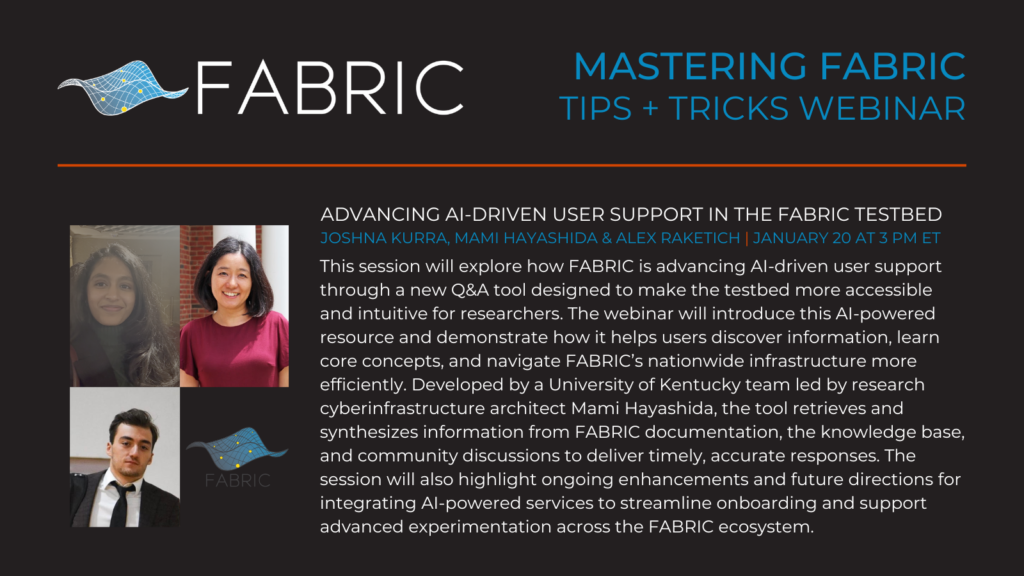
Join us for an in-depth session exploring how FABRIC is advancing AI-driven user support through a Q&A tool designed to make the testbed more accessible, intuitive, and efficient for researchers. This webinar will introduce the new AI-powered resource that streamlines how users discover information, learn core concepts, and navigate FABRIC’s nationwide infrastructure. Developed by a team led by research cyberinfrastructure architect Mami Hayashida at the University of Kentucky, with contributions from UK students Joshna Kurra and Alex Raketich, the tool intelligently retrieves and synthesizes information from FABRIC documentation, the knowledge base, and community discussions to deliver rapid, accurate answers tailored to diverse user needs.
Attendees will learn how this evolving system supports both new and experienced users—whether exploring foundational FABRIC terminology or addressing complex technical challenges that previously required forum-based assistance. The tool, currently available to authenticated users, is undergoing ongoing refinement in accuracy, metadata structure, and documentation to enable broader access and future integration with additional AI-driven capabilities.
The webinar will also highlight how the team is advancing earlier prototypes for automated code support, contributing to a unified suite of intelligent services that enhance onboarding, streamline experimentation, and boost research productivity across the FABRIC ecosystem. Together, these efforts mark a significant step toward delivering seamless, automated assistance within sophisticated research environments, empowering users to focus more deeply on innovative, high-impact experimentation.
The session will conclude with a live Q&A, giving attendees an opportunity to engage directly with the development team. Register Here
Collaboration Opportunity: NSF NAIRR Operations Center Proposal
Partner with the FABRIC team
The NSF NAIRR Operations Center program aims to establish a national infrastructure supporting the secure, equitable, and efficient operation of the National Artificial Intelligence Research Resource (NAIRR). The program seeks proposals that will design, deploy, and manage the core operational capabilities, governance structures, and technical frameworks needed to provide broad access to AI resources, data, and tools for the U.S. research community.
If you’re applying to the new NSF NAIRR Operations Center solicitation, FABRIC is an ideal partner for your Cyberinfrastructure component, offering advanced networking capabilities, programmable infrastructure, and integration support for data-intensive research.Reach out to us at: fabric-info@renci.org
FABRIC News
New AI-Powered Q&A Tool Makes FABRIC More Accessible Than Ever
FABRIC has launched a next-generation AI-powered Q&A tool designed to make the testbed more accessible and accelerate research across its nationwide infrastructure. Developed by research cyberinfrastructure architect Mami Hayashida and a team of University of Kentucky students, the tool synthesizes information from documentation, the knowledge base, and community discussions to provide fast, accurate answers to both basic and technical questions. New users can quickly learn FABRIC concepts, while experienced researchers can resolve complex technical queries without relying on forum responses. Currently available to authenticated users, the tool continues to be refined for accuracy, metadata organization, and future integration with AI-powered features, including automated code support. By streamlining information discovery and lowering the learning curve, this Q&A tool enhances onboarding, boosts research productivity, and represents a major step toward intelligent, automated assistance within complex research environments. Link to full article
Traveling Ciena Node
Ciena has worked in partnership with FABRIC to construct a mini-FABRIC node, known as a “Traveling Fabric Node”. This FABRIC node is designed to be mobile and will be used to support demonstrations, presentations, and experiments at various events and conferences such as Supercomputing, Optical Fiber Conference, and others.
This Traveling Ciena FABRIC node will be located in the Ciena booth (#3330) on the SC25 Exhibit floor. This deployment will include connections thru SCinet and leverage the extensive wide area connectivity engineered into SC25 to connect back to the FABRIC terabit core and associated globally distributed infrastructure. The node provides high-speed connectivity, delivering compute and R&E routed connectivity at 400Gb/s, making it possible for researchers and experimenters to conduct large-scale projects. Nine network research exhibitions (NREs) from institutions including Caltech, ESnet, Northwestern University, University of Chicago, and University of California San Diego will utilize tfNode resources for demos, including high-speed connectivity and compute resources.
Additionally, researchers from the University of Amsterdam will be conducting demonstrations that run on FABRIC at the Ciena Booth throughout the week. These demonstrations will show how privacy-preserving orchestration and policy driver data sharing lead to higher SLA (Subscriber Agreement) compliance and enhanced federated Machine Learning computations. Link to full article
Thread the Needle Blog: Accelerating Scientific Data Movement with EJFAT
A new FPGA-accelerated data transport system called EJFAT is using FABRIC to test high-speed, in-network processing for data-intensive scientific workflows. Designed to handle the extreme data volumes generated at U.S. Department of Energy facilities, EJFAT intelligently segments, routes, and reassembles massive detector data streams to reduce bottlenecks and support terabit-scale throughput. By enabling real- or near-real-time data movement and analysis, the system helps researchers monitor experiments as they run and make more effective use of limited facility time. FABRIC’s nationwide, programmable testbed allows the team to validate EJFAT at realistic scale and advance it toward broader deployment across DOE laboratories. Link to full article
Q3 & Q4 2025 FABRIC Webinar Recap
The FABRIC team hosted three webinars in Q3 and two webinars in Q4 2025 for its user base across two series. Each series is aimed at FABRIC users at different stages in their FABRIC journey.
In the blog, you’ll find descriptions for each series and links to recordings from all of the FABRIC webinars from July through November. Please stay tuned for upcoming webinars next year, and subscribe to the FABRIC YouTube to ensure you see recordings as soon as they’re uploaded.
Learn more about the Q3 & Q4 FABRIC webinar blogs here
Recording from “Bluefield NICs”
Missed our recent webinar? The recording is live.
This session featured Elie Kfoury, who led a technical deep dive into Bluefield NICs Experimentation on FABRIC.
Data Processing Units (DPUs) are programmable processors designed to offload and accelerate workloads and data processing, freeing up CPU resources and improving system performance. This webinar will highlight how researchers can leverage DPUs within FABRIC to accelerate experimentation and enable innovative approaches to distributed computing and networking research.
Participants gained insight into how FABRIC supports DPU integration across testbeds, offering tools for managing high-performance, programmable hardware. The session explored the role of DPUs in enhancing experiment flexibility, performance, and scalability. The webinar included a live demonstration introducing the NVIDIA BlueField-3 DPU and examining its programming models, including the DOCA SDK, P4, and DPDK. Elie showcased how to set up, run, and monitor DPU-based experiments on FABRIC, providing guidance for configuring resources, managing experiments, and applying the workflow within your own experiment.
Educational Use: Using FABRIC for Class Projects
As a national research infrastructure for cutting-edge and exploratory research in networking, distributed computing and science applications, FABRIC encourages faculty to use the infrastructure for teaching their classes. Training next-generation researchers to imagine and construct new computing and networking experiments at-scale is an important goal for FABRIC. FABRIC has created sample experiments and Jupyter notebooks that are ready to be used by networking and systems classes for instructors.
These experiments include basic ping, network routing, exploring IPv6, TCP analysis, traffic generation, setting up a webserver, using Ansible to manage a set of nodes, etc. They are available via github as well as the FABRIC Artifact Manager. Of course, you can create your own assignments for students to do on the FABRIC infrastructure. The FABRIC team provides support from creating an education project, enrolling students, to answering questions from instructors and students. More information can be found here.
FABRIC Ambassador Program
Share your expertise on FABRIC with the world
The FABRIC team is seeking ambassadors to join our team and spread the word about our platform. Ambassadors should have experience running experiments on FABRIC and guiding collaborators through the portal.
FABRIC ambassadors will help researchers learn more about FABRIC and its features through hosting annual local or virtual gatherings, presenting at KNIT workshops and community webinars, and identifying user success stories. Additionally, they will engage students in active learning on the FABRIC portal by leading tutorials and identifying opportunities for students to present their work. Program participants will get the first opportunity to test and approve new features on the FABRIC portal, receive discounts to in-person FABRIC events, and have their research promoted directly to our NSF program managers, as well as our community through social media and mailing channels. Complete our interest form.
FABRIC Office Hours
Connect and troubleshoot with leadership and support
We have made a new office hours system available from the FABRIC portal that allows stakeholders to directly book time with the leadership team and technical team members to discuss anything from the feasibility of their experiments, to software questions, to experiment security, to connecting new facilities into FABRIC.
Book an appointment on our scheduling platform.
Defining FABRIC
A glossary for common terms used by our researchers
Cloud Resource – FABRIC allows access to several types of cloud resources, primarily Internet2-hosted cloud resources for which the user must pay from their own cloud account/budget, CloudBank-funded resources allocated to FABRIC, and Chameleon cloud resources.
See the full glossary on our website.
Open Solicitations
Funding opportunities that encourage the use of FABRIC
Secure and Trustworthy Cyberspace (SaTC): The SaTC program welcomes proposals that address cybersecurity and privacy, drawing on expertise in one or more of these areas: computing, communication, and information sciences; engineering; education; mathematics; statistics; and social, behavioral, and economic sciences. Full proposals can be submitted at any time.
See a list of all solicitations mentioning FABRIC on our website.
Do you have a project idea that would benefit from using FABRIC? The FABRIC team welcomes requests for Letters of Collaboration. To expedite the process, please contact us by filling out the form.
Upcoming Events
See a list of all upcoming events on our website.