
Published: May 15, 2026
What’s new with FABRIC?
An update from Paul Ruth, FABRIC Principal Investigator
We’re excited to share an update on LoomAI, a new open-source, browser-based interface that is transforming how researchers interact with the FABRIC testbed. As the recommended way to use FABRIC, LoomAI replaces traditional command-line and notebook workflows with a more intuitive visual experience, making it easier to design, deploy, and manage experiments. With drag-and-drop topology building, integrated management tools, AI-assisted support, reusable Weaves, and the Artifact Marketplace, LoomAI brings powerful experiment workflows together in one place. Consider attending the LoomAI webinar next week and watch for short LoomAI videos on our YouTube site. We are working toward a full LoomAI video tutorial series.
In this newsletter, you’ll find information about…
- The next FABRIC webinar focused on Getting Started with LoomAI
- FABRIC News
- Opportunities to collaborate with the FABRIC team
Getting Started with LoomAI: A Visual, AI-Powered Interface for FABRIC Experimentation | Mastering FABRIC: Tips and Tricks
May 19, 2026 3:00-4:30 pm ET
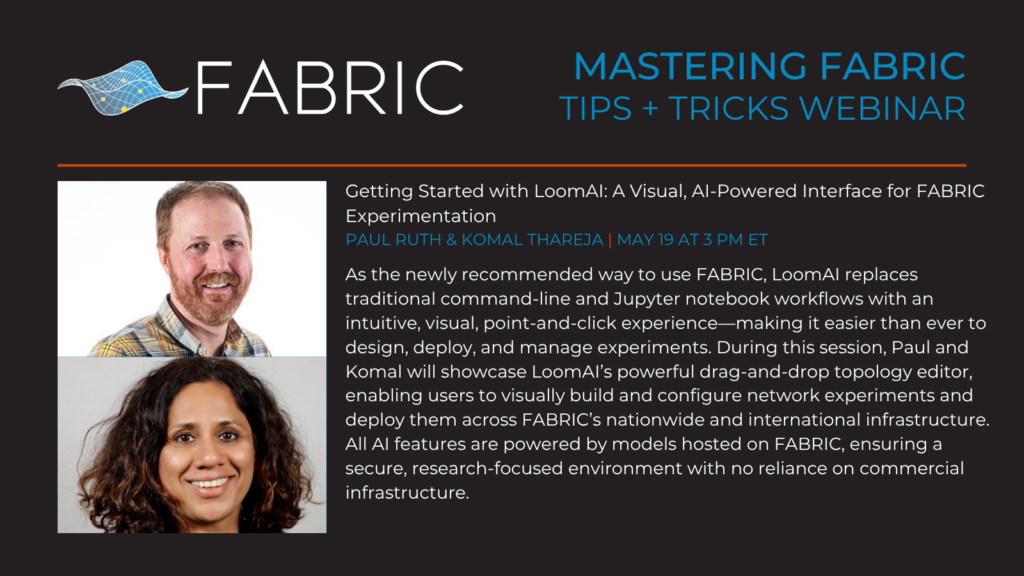
Join us on May 19, 2026, from 3:00–4:30 PM, for an engaging FABRIC Tips & Tricks webinar introducing LoomAI, a new open-source, browser-based interface that transforms how researchers interact with the FABRIC testbed. As the newly recommended way to use FABRIC, LoomAI replaces traditional command-line and Jupyter notebook workflows with an intuitive, visual, point-and-click experience—making it easier than ever to design, deploy, and manage experiments.
During this session, we will showcase LoomAI’s powerful drag-and-drop topology editor, enabling users to visually build and configure network experiments and deploy them across FABRIC’s nationwide and international infrastructure. Attendees will also get a walkthrough of built-in tools—including SSH terminals, a file manager, and a geographic resource map—that streamline experiment management within a single interface.
We’ll also highlight LoomAI’s integrated AI capabilities, including an AI assistant that supports experiment design, troubleshooting, and analysis, along with advanced AI coding tools for deeper development workflows. Additionally, discover “Weaves,” reusable, automated experiment packages, and explore the Artifact Marketplace for sharing and reusing community-driven templates.
All AI features are powered by models hosted on FABRIC, ensuring a secure, research-focused environment with no reliance on commercial infrastructure.
Whether you’re new to FABRIC or looking to modernize your workflow, this webinar will show you how LoomAI can accelerate your research and simplify experimentation from start to finish.
FABRIC News
Researchers Mariam Kiran and Shashwitha Puttaswamy are using the FABRIC testbed to explore how AI can make network traffic engineering more adaptive and efficient. Instead of relying on fixed routing rules, their system uses real-time network conditions to steer data along the best path for different workloads, helping improve performance for both large scientific data transfers and smaller, latency-sensitive flows. Early results show major gains in round-trip time and bandwidth, and the project points toward a future where decentralized AI agents could help manage complex, large-scale networks more intelligently.
Full article can be found here: https://learn.fabric-testbed.net/knowledge-base/teaching-networks-to-think-ai-driven-traffic-engineering-on-fabric/
CREASE is a debugging tool built for FABRIC that helps researchers more easily understand what is happening inside complex network experiments. Instead of manually checking multiple nodes and collecting traces by hand, users can monitor specific parts of a topology, narrow analysis to the time when something went wrong, and quickly identify where packet loss or unexpected behavior occurred. Designed for evolving research prototypes and programmable networking experiments, CREASE reduces debugging friction and helps researchers spend less time troubleshooting and more time iterating on their work.
Full article can be found here: https://learn.fabric-testbed.net/knowledge-base/fabric-tips-tricks-debugging-smarter-with-crease/
Researchers at the University of Missouri are using FABRIC to apply AI and machine learning to a large cancer dataset from Memorial Sloan Kettering in order to better predict survivability and uncover clinically meaningful patterns across thousands of metastatic cancer cases. By combining clinical and genomic expertise with FABRIC’s accessible computing environment, the team can run large-scale analyses, iterate quickly, and avoid the cost and complexity of building their own infrastructure. Their work is laying the groundwork for future AI-driven cancer research, including genomic modeling, rare cancer analysis, and pathology image interpretation. Full article can be found here: https://learn.fabric-testbed.net/knowledge-base/powering-ai-driven-cancer-informatics-on-fabric/
Educational Use: Using FABRIC for Class Projects
As a national research infrastructure for cutting-edge and exploratory research in networking, distributed computing, and science applications, FABRIC encourages faculty to use the infrastructure for teaching their classes. Training next-generation researchers to imagine and construct new computing and networking experiments at scale is an important goal for FABRIC. FABRIC has created sample experiments and Jupyter notebooks that are ready to be used by networking and systems classes for instructors.
These experiments include basic ping, network routing, exploring IPv6, TCP analysis, traffic generation, setting up a web server, using Ansible to manage a set of nodes, etc. They are available via GitHub as well as the FABRIC Artifact Manager. Of course, you can create your own assignments for students to do on the FABRIC infrastructure. The FABRIC team provides support from creating an education project, enrolling students, to answering questions from instructors and students. More information can be found here.
FABRIC Office Hours
Connect and troubleshoot with leadership and support
We have made a new office hours system available from the FABRIC portal that allows stakeholders to directly book time with the leadership team and technical team members to discuss anything from the feasibility of their experiments, to software questions, to experiment security, to connecting new facilities into FABRIC.
Book an appointment on our scheduling platform.
Defining FABRIC
A glossary for common terms used by our researchers
Stitching – Originally coined from the GENI testbed, stitching is a FABRIC service that allows users to create links between experiments and facilities.
See the full glossary on our website.
Solicitations
Funding opportunities that encourage the use of FABRIC
See a list of all solicitations mentioning FABRIC on our website.
Do you have a project idea that would benefit from using FABRIC? The FABRIC team welcomes requests for Letters of Collaboration. To expedite the process, please contact us by filling out the form.
Upcoming Events
See a list of all upcoming events on our website.