
What’s new with FABRIC?
An update from Paul Ruth, FABRIC Principal Investigator
We look forward to seeing you at our upcoming KNIT, scheduled for April 2026 in Hawaii! Join the community for engaging discussions, collaboration, and hands-on exploration of FABRIC and next-generation networking. More details and registration information can be found below.
If you have ideas for getting more involved with FABRIC, whether by being featured in our FABRIC Webinar Series, presenting at the next KNIT workshop, or contributing to community initiatives, we’d love to hear from you.
Reach out to Chelsea Davis, Project Manager, at cdavis@renci.org, and she will connect you with the appropriate FABRIC team member.
In this newsletter, you’ll find information about…
- KNIT12 Registration Open
- Golden Stitch Award: Call for Nominations
- The next FABRIC webinar focused on using distributed storage to preserve and reuse experiments
- FABRIC REU Sites Application – Summer 2026
- Opportunities to collaborate with the FABRIC team
KNIT 12: Registration Open
April 14-17, 2026 | Honolulu, HI
We cordially invite you to join us for KNIT 12, the next FABRIC Community Workshop, taking place April 14 – 17 in Honolulu, HI.
This engaging multi-day event offers a dynamic mix of activities designed to deepen your knowledge of FABRIC, connect with fellow researchers, and contribute to the future of this innovative platform.
Event Highlights:
- Hands-On FABRIC Tutorials: Participate in small-group sessions tailored for both newcomers and experienced users.
- Advanced Training Topics: Explore in-depth technical content to enhance your expertise.
- Plenary Sessions: Gain insights from expert presentations and open discussions.
- Experiment Showcases: Discover how scientists from diverse fields are leveraging FABRIC to drive groundbreaking research.
- Open Mic Sessions: Share your feedback and ideas to shape FABRIC’s future development.
Don’t miss this chance to explore practical applications, network with the community, and be part of the evolution of FABRIC!
KNIT12 Registration open!
KNIT12 invites participants to share talks on experimentation across scientific domains, getting started with FABRIC, and innovative uses of FABRIC and other testbeds. Speakers are encouraged to showcase active experiments with live views of slices, resources, and results, or propose new ideas with clearly defined workflows and resource needs. This is a great opportunity to highlight your work, exchange insights, and contribute to the growing FABRIC community. Please complete this form by February 27, 2026, if you are interested in presenting at KNIT12.
KNIT12 Demo Night:
Showcase your innovative projects at KNIT12’s Demo Night! Share the work you’ve been developing by filling out the form to be considered for a presentation.
If you have never participated in a Demo/Poster night, the layout will be like a trade show, with each presenter at a “booth” (each presenter will get a table around the room). Thank you for expressing interest in presenting at Demo Night. Please complete this form by March 16.
Golden Stitch Award 2026: Call for Nominations
Recognizing Innovation in the FABRIC Community
FABRIC is excited to announce the 2026 Golden Stitch nomination process, highlighting the innovative research and educational work happening across our user community.
We invite you to nominate yourself or a colleague who has demonstrated exceptional use of FABRIC resources through impactful experimentation, research, or teaching.
Award Categories:
- Best Published Paper
- Best FABRIC Matrix
- Best FABRIC Experiment (must be packaged as an artifact in the Artifact Manager)
- Best Classroom Use of FABRIC
Eligibility:
- Nominations must actively use FABRIC.
- Submissions may be self-nominations or peer nominations.
Selection Process:
All nominations will be reviewed by the FABRIC Leadership Team. Winners will be selected based on innovative use of FABRIC resources, experiment design, and execution.
Recognition:
Winners will be recognized at KNIT12 (Spring 2026) with a certificate of achievement and will be featured in a FABRIC blog post highlighting their work.
Submit Your Nomination:
Nominations are collected via Google Form through March 31, 2026.
Submit a Nomination via this link
Help us celebrate the individuals who are stitching together the next generation of research and innovation with FABRIC.
Using Distributed Storage to Preserve and Reuse Your Experiment Data | Mastering FABRIC: Tips and Tricks
March 17, 2026 3:00-4:30 pm ET
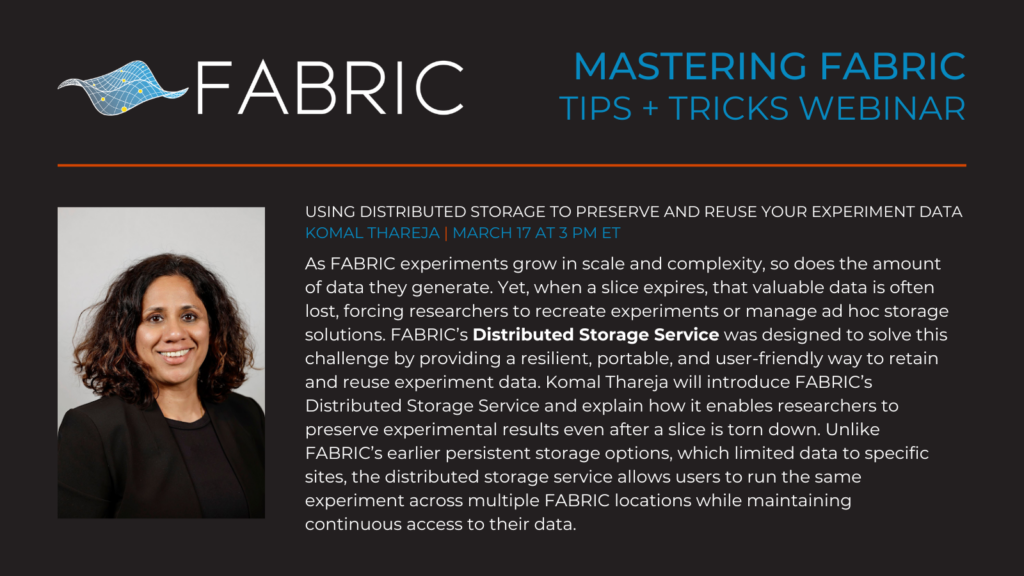
Join us March 17, 2026, at 3:00 PM ET for a FABRIC Tips & Tricks webinar exploring how FABRIC’s Distributed Storage Service helps researchers preserve, access, and reuse experiment data across the platform.
As FABRIC experiments grow in scale and complexity, so does the amount of data they generate. Yet, when a slice expires, that valuable data is often lost, forcing researchers to recreate experiments or manage ad hoc storage solutions. FABRIC’s Distributed Storage Service was designed to solve this challenge by providing a resilient, portable, and user-friendly way to retain and reuse experiment data.
In this session, Komal Thareja will introduce FABRIC’s Distributed Storage Service and explain how it enables researchers to preserve experimental results even after a slice is torn down. Unlike FABRIC’s earlier persistent storage options, which limited data to specific sites, the distributed storage service allows users to run the same experiment across multiple FABRIC locations while maintaining continuous access to their data.
Participants will learn how the service is built and deployed within FABRIC, how it leverages Ceph to maintain three copies of every dataset for resilience, and how this architecture protects data even when individual nodes fail. The session will also walk through a practical example showing how users can request storage, attach it to their experiments, and easily retrieve their data across runs.
Whether you are running long-term experiments, iterating on workflows, or moving between FABRIC sites, this session will show you how distributed storage makes your data persistent, portable, and protected, so your research doesn’t disappear when your slice does.
Now Open: FABRIC REU Sites Application – Summer 2026
Applications are now open for the NSF Research Experiences for Undergraduates (REU) Site: Multi-disciplinary Research with the FABRIC Network, hosted by the Renaissance Computing Institute (RENCI) at UNC–Chapel Hill. This 9-week, full-time summer program (May 25–July 24, 2026) offers undergraduate students hands-on research experience using the NSF FABRIC nationwide testbed.
Participants will work on cutting-edge projects at the intersection of advanced networking, distributed systems, machine learning, cybersecurity, and emerging cyberinfrastructure, with potential topics including P4 and FPGA-based networking, in-band telemetry, ML-driven cybersecurity, federated learning, TCP congestion control, and AI-assisted medical imaging.
Each cohort will include eight undergraduate students supported by faculty, researchers, peer mentors, and FABRIC staff. The program begins with a 3-week core phase focused on training, workshops, and FABRIC onboarding, followed by a 6–7 week research phase where students collaborate closely with mentors and present their findings at the end of the program.
Eligibility: Open to U.S. citizens, nationals, or permanent residents who are enrolled undergraduates in good academic standing, with Python proficiency and basic computer systems knowledge.
Application deadline: April 10, 2026
Final decisions announced: April 31, 2026
Learn more and apply to join a vibrant, multidisciplinary research community powered by FABRIC.
More information can be found linked here
Educational Use: Using FABRIC for Class Projects
As a national research infrastructure for cutting-edge and exploratory research in networking, distributed computing and science applications, FABRIC encourages faculty to use the infrastructure for teaching their classes. Training next-generation researchers to imagine and construct new computing and networking experiments at scale is an important goal for FABRIC. FABRIC has created sample experiments and Jupyter notebooks that are ready to be used by networking and systems classes for instructors.
These experiments include basic ping, network routing, exploring IPv6, TCP analysis, traffic generation, setting up a web server, using Ansible to manage a set of nodes, etc. They are available via GitHub as well as the FABRIC Artifact Manager. Of course, you can create your own assignments for students to do on the FABRIC infrastructure. The FABRIC team provides support from creating an education project, enrolling students, to answering questions from instructors and students. More information can be found here.
FABRIC Ambassador Program
Share your expertise on FABRIC with the world
The FABRIC team is seeking ambassadors to join our team and spread the word about our platform. Ambassadors should have experience running experiments on FABRIC and guiding collaborators through the portal.
FABRIC ambassadors will help researchers learn more about FABRIC and its features through hosting annual local or virtual gatherings, presenting at KNIT workshops and community webinars, and identifying user success stories. Additionally, they will engage students in active learning on the FABRIC portal by leading tutorials and identifying opportunities for students to present their work. Program participants will get the first opportunity to test and approve new features on the FABRIC portal, receive discounts to in-person FABRIC events, and have their research promoted directly to our NSF program managers, as well as our community through social media and mailing channels. Complete our interest form.
FABRIC Office Hours
Connect and troubleshoot with leadership and support
We have made a new office hours system available from the FABRIC portal that allows stakeholders to directly book time with the leadership team and technical team members to discuss anything from the feasibility of their experiments, to software questions, to experiment security, to connecting new facilities into FABRIC.
Book an appointment on our scheduling platform.
Defining FABRIC
A glossary for common terms used by our researchers
Cloud Resource – FABRIC allows access to several types of cloud resources, primarily Internet2-hosted cloud resources for which the user must pay from their own cloud account/budget, CloudBank-funded resources allocated to FABRIC, and Chameleon cloud resources.
See the full glossary on our website.
Solicitations
Funding opportunities that encourage the use of FABRIC
See a list of all solicitations mentioning FABRIC on our website.
Do you have a project idea that would benefit from using FABRIC? The FABRIC team welcomes requests for Letters of Collaboration. To expedite the process, please contact us by filling out the form.
Upcoming Events
See a list of all upcoming events on our website.