

What’s new with FABRIC?
An update from Paul Ruth, FABRIC Principal Investigator
We are excited to promote the many users planning great demos and talks next week at SC24. These include several demonstrations that will use the traveling Ciena FABRIC site that will be on the SC exhibition floor and accessible for experimentation while SC is in progress. We hope to see you at SC24 and make sure to look for talks involving FABRIC experiments.
We encourage all users to register for our upcoming November webinars and keep an eye out for more information about our December events.
In this newsletter, you’ll find information about…
- FABRIC activities at SC24
- November webinars for new and experienced users
- Fall webinar recordings
- Stories on user experiments
- User resources, open solicitations, upcoming events, and more!
FABRIC at Supercomputing 2024
Swing by and see us at Booth #3923

Those interested in learning more about FABRIC at Supercomputing 2024 will be able to visit RENCI’s in-person booth (#3923) and learn about updates to the project.
FABRIC PI Paul Ruth will present two talks at the booth, accompanied by various FABRIC users. Check out the times below and stay up to date with the latest presenters on our SC24 page.
- Wednesday, November 20 at 11:30 AM ET
- Using AI/ML with P4 on Baric for intelligent routing | Mariam Kiran, ORNL
- Using CREASE Tooling to smoothen your Testbed Experiment experience | Nik Sultana, Illinois Institute of Technology
- FABRIC And Data Intensive Science Prototype Services | Joe Mambretti, Northwestern University and StarLight
- Thursday, November 21 at 1:00 PM ET
- Multi-Domain Experiments Using ESnet SENSE on the National Research Platform / PacWave / FABRIC | Mohammad Firas Sada, San Diego Supercomputer Center
- Traffic Steering Without the Switch: Offloading Big Flows to the NIC | Justas Balcas, ESNet
FABRIC will be represented at the 2024 INDIS Workshop Technical Session on Tuesday November 19 at 11 AM CT at the SCinet Theater (#2049) on the exhibit floor. PI Paul Ruth will share FABRIC updates from the past year and two FABRIC users will show demos of their FABRIC experiments.
- Status of FABRIC integration with the National Research Platform (NRP) | Frank Wuerthwein, UCSD
- Global P4 Lab | Marcos Schwarz, RNP
Beyond Booth #3923, we’re excited to announce that there will be FABRIC facility ports at SCinet at several booths this year in addition to RENCI, including:
- StarLight | Booth #2551
- California Institute of Technology / CACR | Booth #845
- CIENA | Booth #1940
Ciena has worked in partnership with FABRIC to construct a mini-FABRIC node, known as a “Traveling Fabric Node”. This FABRIC node is designed to be mobile and will be used to support demonstrations, presentations, and experiments at various events and conferences such as Supercomputing, Optical Fiber Conference, and others. This Traveling Ciena built FABRIC node will be located in the Ciena booth on the SC24 Exhibit floor. This deployment will include connections thru SCinet and leverage the extensive wide area connectivity engineered into SC24 to connect back to the FABRIC terabit core and associated globally distributed infrastructure. This provides an opportunity for FABRIC users to demonstrate innovative research/experiments which can span the FABRIC core infrastructure and resources at the SC24 Exhibit Venue, including to other SC24 participant booths.
Check out our website for a full list of events.
Facility Ports
November 25 at 3 PM ET | Mastering FABRIC: Tips and Tricks Webinar

Join us for a comprehensive webinar on FABRIC’s “Facility Ports,” dedicated to unlocking the potential of FABRIC’s facility ports and their capabilities, featuring FABRIC lead team member Tom Lehman and FABRIC user Ben Formby. The tutorial will explore the powerful capabilities of FABRIC’s facility ports, including practical guidance on how they can be utilized effectively within experimental setups.
This tutorial will cover an overview of facility ports, detailing their benefits and considerations for practical use. Tom will break down the two primary ways to access facility ports: first, by providing step-by-step guidance on requesting facility port creation, and second, by explaining how to use the facility ports with Chameleon. Tom will illustrate these concepts with two straightforward examples, clarifying each method’s process and application.
Additionally, the speakers will present two real-world use cases to deepen your understanding of these approaches.
- Use Case #1: Facility Port Creation—the ERN CryoEM use case will be further discussed during Maureen Dougherty’s User-Led Webinar on November 26.
- Use Case #2: Chameleon Integration – Ben Formby’s experience and insights on leveraging Chameleon with facility ports will be showcased live during the webinar.
The webinar will conclude with a 20-minute Q&A session, providing an open forum to ask questions, clarify details, and gain insights from our presenters.
Register on our website.
ERN CryoEM and FABRIC
November 26 at 2 PM ET | Stitching Together Innovation with FABRIC Users
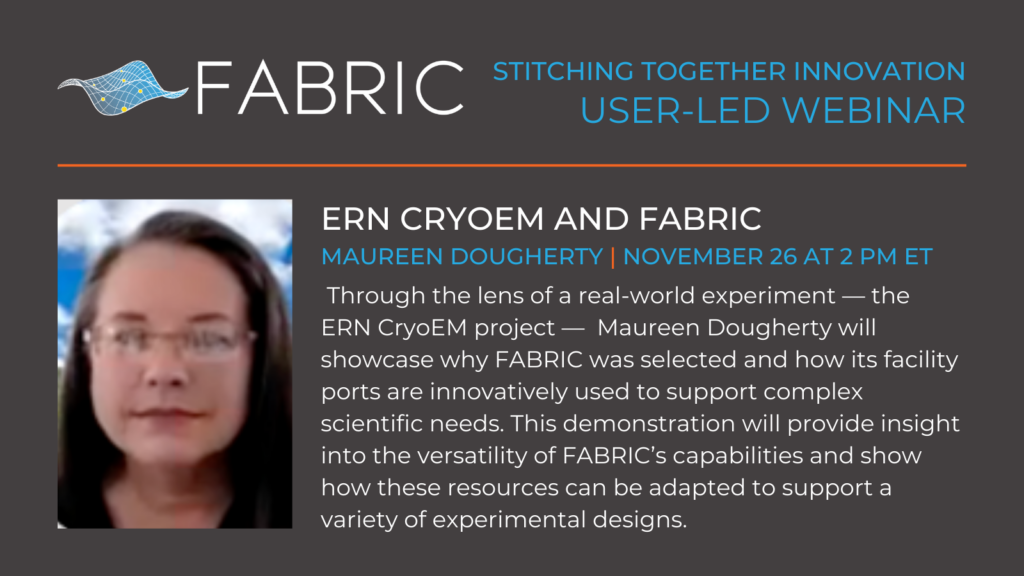
Explore how FABRIC’s unique network and computing resources can elevate your research during our webinar on “ERN CryoEM and FABRIC.” Through the lens of a real-world experiment — the ERN CryoEM project — Maureen Dougherty will showcase why FABRIC was selected and how its facility ports are innovatively used to support complex scientific needs. This demonstration will provide insight into the versatility of FABRIC’s capabilities and show how these resources can be adapted to support a variety of experimental designs.
Attendees will:
- Understand FABRIC’s resources and how they can enhance experimental research.
- Explore the benefits of using FABRIC’s facility ports to support innovative project setups.
- Gain actionable insights on utilizing FABRIC’s resources in their experiments.
The session will conclude with a 15-minute Q&A, during which attendees can ask questions and receive insights from our presenter.
Register on our website.
FABRIC Webinar Recordings
Missed our recent webinars? The recordings are live.
SciStream and FABRIC featuring Joaquin Chung
August 19 at 2 PM ET | Stitching Together Innovation with FABRIC Users
This exciting and insightful session features Joaquin Chung from the Argonne National Lab. Dr. Chung provides an introduction of SciStream, detailing how the platform was conceived and the journey leading to its adoption of FABRIC for experiments. Watch the recording.
Exploring Different Network Interfaces featuring Paul Ruth
August 20 at 3 PM ET | Mastering FABRIC: Tips and Tricks Webinar
This informative webinar features network expert Paul Ruth. The tutorial provides a comprehensive overview of FABRIC’s different types of network interfaces. Dr. Ruth explains the different capabilities of these interfaces and how to utilize them. Watch the recording.
Artifact Manager featuring Komal Thareja and Michael J. Stealey
September 16 at 3 PM ET | Mastering FABRIC: Tips and Tricks Webinar
The presenters provide an insightful overview of the Artifact Manager, showcasing its features through real-world examples and a mix of UI and API interactions. The FABRIC Artifacts Manager is a great tool for packaging and sharing your complete, repeatable FABRIC experiments. The webinar will guide you through a practical, hands-on tutorial on using the Artifact Manager within JupyterHub. Watch the recording.
AI / ML Experiments featuring Ben Formby
September 17 at 2 PM ET | Stitching Together Innovation with FABRIC Users
During the session, Ben Formby delves into the world of AI/ML experiments, leveraging the cutting-edge capabilities of the FABRIC testbed. This session provides a comprehensive overview of Ben’s AI/ML experiment involving medical images, exploring the motivations behind his work and why FABRIC was the testbed of choice. Watch the recording.
Poseidon and FABRIC featuring Cong Wang, Imtiaz Mahud, and Mariam Kiran
October 21 at 3 PM ET | Stitching Together Innovation with FABRIC Users
This insightful webinar features Cong Wang, Imtiaz Mahud, and Mariam Kiran as they introduce and demonstrate Poseidon, a tool designed to optimize big data flows across various facilities by leveraging the FABRIC platform. This session begins with a concise overview of Poseidon’s capabilities, highlighting its role in connecting large-scale data networks and enhancing their efficiency. The presenters discuss the importance of FABRIC and the exclusive features that support Poseidon’s network optimization efforts. Watch the recording.
How to Use the Data in FABRIC featuring Jim Griffioen and Charles Carpenter
October 22 at 2 PM ET | Mastering FABRIC: Tips and Tricks Webinar
This webinar is a deep dive into utilizing a wealth of data measured on the FABRIC platform. In this session, Jim Griffioen and Charles Carpenter guide participants through the essential features that make FABRIC a unique and powerful tool for data-driven research and innovation. The webinar covers the importance of FABRIC in advancing network experimentation, highlights its exclusive capabilities, and provides a hands-on demo on how to use the data within FABRIC effectively. The session also offers valuable resources for further exploration. Watch the recording.
Thread the Needle: Extending Local 5G Slicing for Seamless, Secure Remote Global Connectivity
FABRIC testbed used to simulate local 5G hotspots set up across transcontinental distances
Whether traveling or working from home, remote workers often use Wi-Fi networks and VPNs with separate authentication devices to access critical company resources from locations around the world. Wrestling with slow, insecure connections not only hinders productivity but also leaves sensitive data vulnerable.
To address this challenge, Professor Akihiro Nakao at the University of Tokyo and Fatou Secka, a master’s student in Nakao’s lab, are working to extend local 5G secure networking across transcontinental network slices. Their goal is to develop a solution that provides secure and easy-to-use high-performance connectivity for global businesses and industrial IoT applications.
Read the blog.
Thread the Needle: Harnessing AI-Powered Image Analysis to Transform Pain Diagnosis
FABRIC testbed helps researchers optimize machine learning and data transfer for real-time ultrasound image processing
To treat pain, current medical practices rely heavily on pharmaceuticals. However, this approach doesn’t address the root causes of the pain and comes with side effects and a risk of dependency. A new collaborative project at Clemson University aims to find better ways to treat pain by combining advanced ultrasound imaging with machine learning to uncover the deeper, often hidden, causes of pain.
The project, inspired by the NIH’s Helping to End Addiction Long-term (NIH HEAL) Initiative and funded as a team science project through SC-TRIMH – a NIH COBRE center at Clemson University, brings together an interdisciplinary team of experts, including physicians, computer scientists and imaging experts, to figure out how to better visualize and understand the physical markers of pain within muscle tissues and tendons. The goal is to eventually make it possible for more physicians to use ultrasound to diagnose pain in their clinics.
Read the blog.
Request for Users: Update Project Page
The FABRIC team wants you to share your user story
As the number of FABRIC users grows, we want to encourage users to share their work and project progress on the portal. Sharing your user story is crucial for the continued success of FABRIC.
Updating your page will increase opportunities for collaboration and cross-pollination with FABRIC users across the world, aid in the advancement of user-made tools and resources, and provide a home for citations and external links.
- Update Your Project Description: Provide a brief description of your project that can be shared with NSF program managers who support our funding.
- Share Your Publications: If you have published any papers using FABRIC, include them on your project page. Please cite FABRIC in your papers.
- Provide External Links: If your project has a website or other external sources of information, please include them on your project page.
- Update FABRIC Matrix: Create or update your FABRIC Matrix to reflect the current status of your project.
Please feel free to reach out with any questions. We are happy to support you in this endeavors and provide guidance.
FABRIC Ambassador Program
Share your expertise on FABRIC with the world
The FABRIC team is seeking ambassadors to join our team and spread the word about our platform. Ambassadors should have experience running experiments on FABRIC and guiding collaborators through the portal.
FABRIC ambassadors will help researchers learn more about FABRIC and its features through hosting annual local or virtual gatherings, presenting at KNIT workshops and community webinars, and identifying user success stories. Additionally, they will engage students in active learning on the FABRIC portal by leading tutorials and identifying opportunities for students to present their work. Program participants will get the first opportunity to test and approve new features on the FABRIC portal, receive discounts to in-person FABRIC events, and have their research promoted directly to our NSF program managers, as well as our community through social media and mailing channels.
Complete our interest form.
FABRIC Office Hours
Connect and troubleshoot with leadership and support
We have made a new office hours system available from the FABRIC portal that allows stakeholders to directly book time with the leadership team and technical team members to discuss anything from the feasibility of their experiments, to software questions, to experiment security, to connecting new facilities into FABRIC.
Book an appointment on our scheduling platform.
Defining FABRIC
A glossary for common terms used by our researchers
Model: The term model is synonymous to model when referring to the “make and model” of a car. FABRIC allows users to select different models of the network components they wish to include in their topology design.
See the full glossary on our website.
Open Solicitations
Funding opportunities that encourage the use of FABRIC
Computer and Information Science and Engineering Research Expansion Program: With this solicitation, the National Science Foundation’s (NSF) Directorate for Computer and Information Science and Engineering (CISE) is continuing its support of research expansion for Minority-Serving Institutions (MSIs). The goal of the CISE MSI program is to broaden participation by increasing the number of CISE-funded research projects from MSIs and to develop research capacity toward successful submissions to core CISE programs. MSIs are central to inclusive excellence: they foster innovation, cultivate current and future undergraduate and graduate computer and information science and engineering talent, and bolster long-term U.S. competitiveness. Full proposals are due February 7, 2025.
Secure and Trustworthy Cyberspace (SaTC): The SaTC program welcomes proposals that address cybersecurity and privacy, drawing on expertise in one or more of these areas: computing, communication, and information sciences; engineering; education; mathematics; statistics; and social, behavioral, and economic sciences. Full proposals can be submitted at any time.
See a list of all solicitations mentioning FABRIC on our website.
Do you have a project idea that would benefit from using FABRIC? The FABRIC team welcomes requests for Letters of Collaboration. To expedite the process, please contact us by filling out the form.
Upcoming Events
Leadership team presence at industry or academic events
Supercomputing 2024: Our world is changing rapidly. Complex challenges are suddenly arising alongside an urgent demand for answers. Leveraging HPC, skilled minds employ innovative technologies to respond to the call — driven by data, simulating possibilities, and unlocking new solutions. By harnessing the power of HPC, the SC community is unleashing a deeper understanding of our world at an unprecedented pace. FABRIC PI Paul Ruth will be on the exhibit floor at RENCI Booth (#3923). The event will take place in Atlanta, GA from November 17-22.
Community Workshop on Practical Reproducibility in HPC: This workshop aims to advance the concept of practical reproducibility in HPC – a practice where reproducing results becomes a mainstream method of scientific exploration. It will provide a forum for debate on the tools, services, and approaches that best support reproducibility in HPC and systems science, concluding with a comprehensive report that captures the community’s collective knowledge and recommendations for advancing practical reproducibility in HPC and systems research.The event will take place in Atlanta, GA from November 18.
See a list of all upcoming events on our website.