

Forum Replies Created
-
AuthorPosts
-
May 21, 2026 at 5:09 pm in reply to: Request for Host Cold Power Cycle to Apply BlueField-3 DOCA SNAP Firmware Config #9800
does CloudLab provision an easier way to perform cold reboots?
Both CloudLab and Chameleon Cloud offer physical machines, so that you can initiate the hard reboot from within the operating system. It’s also possible to perform a power cycle, but this isn’t usually necessary to apply firmware parameter changes.
The drawback is tighter experiment durations because there are fewer resources on these platforms.
May 21, 2026 at 8:36 am in reply to: Request for Host Cold Power Cycle to Apply BlueField-3 DOCA SNAP Firmware Config #9797There are several features that require hard host reboot:
- Bluefield PCI switch emulation (mentioned by OP)
- ConnectX-6 GTP-U parser (encountered by myself before I moved to Cloudlab)
- FPGA flashing (well documented)
However, an immediate reboot would affect other nodes running on the same host.
I think FABRIC could solve this in several ways:
- The slice configuration declares requested settings, and then the control framework chooses a host that already has a card in that setting.
- If none of the available cards has this setting, but a host is idle, the control framework can apply the setting and reboot the host during the provisioning process.
- If a card exists with this setting but it’s occupied, the experiment is scheduled at a future date on this card, and the current slice on this card is blocked from extending.
- If none of the cards have this setting so that a reboot is unavoidable, the experiment is scheduled at a future date, and all existing slices are blocked from extending, so that the control framework has an opportunity to apply the setting and reboot the host.
This system would be fully automated and does not require recurring staff involvement.
May 7, 2026 at 2:36 pm in reply to: Requesting exclusive/dedicated CPU core allocation for performance-sensitive exp #9771You can try the cpupin_common script that eliminates four of five layers of CPU interference:
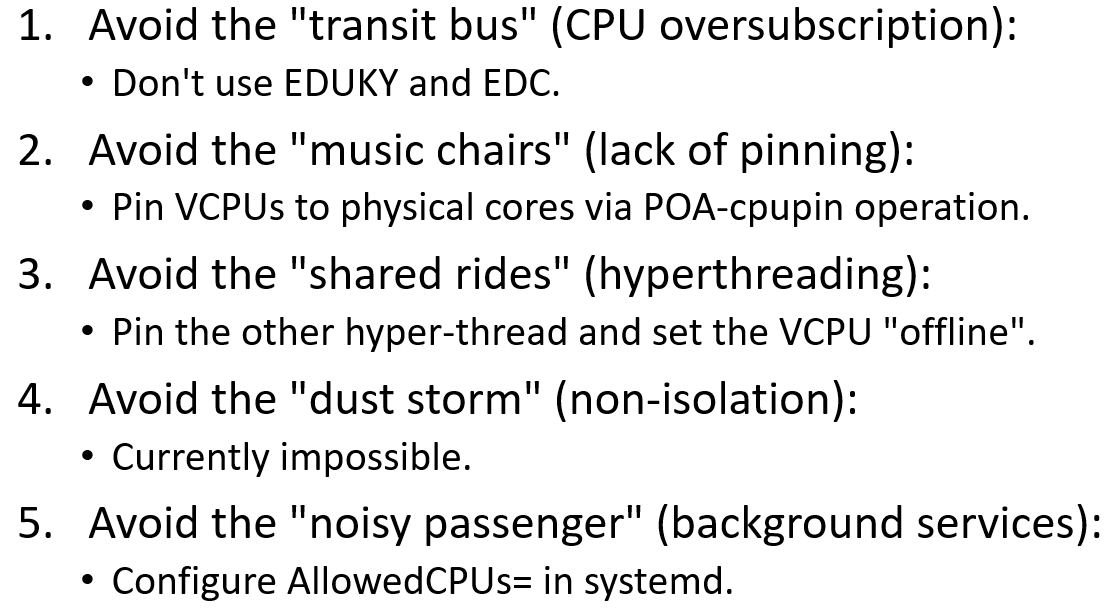
The NIST-MQNS artifact contains a concrete example of using this script to perform a CPU-bound benchmark of a Python application.
There is a regression related to POA functionality in JupyterLab.
Given this script:
import time

from fabrictestbed_extensions.fablib.fablib import FablibManager as fablib_manager

fablib = fablib_manager()
sliceNum = int(time.time())
sliceName = f'demo@{sliceNum}'
print(sliceName)

slice = fablib.new_slice(name=sliceName)
node = slice.add_node(name='vm', site='SRI', cores=4, image='docker_ubuntu_24')
slice.submit()

slice.update()
node = slice.get_node(node.get_name())
print(node.get_cpu_info())
It works in:
- (default) FABRIC Examples v1.9.0, FABlib v1.9.3: released: 07/28/2025, stable: Summer 2025
It does not work in:
- (bleeding edge) FABRIC Examples latest, FABlib latest, Current Release
- (beyond bleeding edge) FABRIC Examples (main branch), FABlib (main branch)
For the latter two options, it would throw error:
fabric@summer:work-18%$ python demo.py User: shijunxiao@arizona.edu bastion key is valid! Configuration is valid demo@1774903714 Waiting for slice . Slice state: StableOK Waiting for ssh in slice . ssh successful Running post boot config ... Running post boot config threads ... Post boot config vm, Done! (1 sec) Saving fablib data... Done! Done! Traceback (most recent call last): File "/home/fabric/work/demo.py", line 17, in print(node.get_cpu_info()) ^^^^^^^^^^^^^^^^^^^ File "/opt/conda/lib/python3.11/site-packages/fabrictestbed_extensions/fablib/node.py", line 4393, in get_cpu_info cpu_info = self.poa(operation="cpuinfo") ^^^^^^^^^^^^^^^^^^^^^^^^^^^^^ File "/opt/conda/lib/python3.11/site-packages/fabrictestbed_extensions/fablib/node.py", line 4314, in poa raise Exception(f"Failed to issue POA - {operation} Error {poa_info}") Exception: Failed to issue POA - cpuinfo Error sri-w1.fabric-testbed.netMarch 24, 2026 at 5:57 am in reply to: Policy question: external download experiments and management-network usage on F #9605You should be using FABNetv4Ext and FABNetv6Ext network types, which allows bulk downloads from Internet.
When I last used these, it appeared that they only peer with Internet at NEWY WASH STAR. This means you should deploy your slices in or near these sites for the best latency.
The “FABRIC Site Hardware Configurations” webpage only says “AMD 7532 or 7543”, but doesn’t specify which site/node has which CPU model. Moreover, I’m seeing EPYC 7H12 at EDC site: it’s the same generation as 7532 but has a higher frequency, which would yield different results for a compute benchmark.
I see there’s a “FABRIC NVMe Drives” webpage that lists the specific NVMe model for each site. Maybe there could be another webpage for the CPU model as well?
December 12, 2025 at 10:27 pm in reply to: Cannot SSH into NS2 and NS4 nodes, need to preserve data (PhD simulations) #9267Cannot SSH into NS1 and NS5 nodes, need to preserve data (PhD simulations)
I found that the authorized_keys file on both NS1 and NS5 was empty, which is why SSH—whether through the admin key or the Control Framework—was failing resulting in POA/addKey failure. It seems this may have happened unintentionally as part of the experiment.
Please be careful not to remove or overwrite the authorized_keys file in the process.
Given this is a commonly occurring user error, maybe the OS images should include a separate account for Control Framework / POA access?
I have important simulation data stored on these nodes, and I cannot lose this data.
While I hope you can get the data back, you should setup automated backup for important data. FABRIC and Cloudlab machines should be considered ephemeral and are not suitable for important storage.
I learned the importance of full backups during my PhD simulations: while I downloaded both the program code and the outcome files, I neglected to save the parameters used to launch the program. After a disk failure, I had to spend multiple weeks to reconstruct the input parameters and command lines.
September 5, 2025 at 6:13 pm in reply to: BSD images cause error- channel 0: open failed: connect failed: No route to host #8897I haven’t used BSD in a decade, but I recall some BSD systems do not have IPv6 enabled by default or their SSH server isn’t listening on IPv6.
You can confirm this hypothesis by trying to create the nodes on a site that has IPv4 management addresses.
August 22, 2025 at 8:49 am in reply to: JupyterLab Save Error: No Space Left on Device in FABRIC Slice #8840You can specify the disk size in
slice.add_node(disk=)parameter.
https://fabric-fablib.readthedocs.io/en/latest/slice.html#fabrictestbed_extensions.fablib.slice.Slice.add_nodeAs said in the quoted notebook:
In this example, the switch daemon automatically terminates after 5 minutes, which may cause the ping to stop working beyond this duration. This is expected behavior.
The timeout is passed as a parameter to execute_thread:
("sleep infinity", r"bf-sde>", 300)
This tuple sends “sleep infinity” command to the switch and waits 300 seconds for “bf-sde>” prompt. Since the prompt never appears, the timeout arrives and shuts down the SSH connection.
In Unix, a disconnected SSH connection triggers SIGHUP, hence the process is killed.
April 30, 2025 at 3:33 pm in reply to: How to automate a script that creates a slice, deploys 2 VMs on different sites #8454Step 1-5 are easy to do.
I’d like this script to run automatically once or twice per week
This is the difficult part.
I believe it’s impossible within JupyterHub, because the container shuts down after an hour.It should be possible to install FABlib on your own server and invoke a script that does step 1-5 via crontab.
This then requires you obtain a long-lived authentication token, and then it’s set-and-forget until the token expires.I’m trying out the new
docker_ubuntu_24OS image and the updateddocker_ubuntu_22OS image, and noticed three issues:docker buildis using the legacy Docker builder that has been deprecated. Packagedocker-buildx-pluginshould be included in the image.- The
docker composecommand is missing. Compose is commonly used in Docker based applications including some fablib examples (they are currently usingdocker_rocky_8or manually installing Compose). Packagedocker-compose-pluginshould be included in the image. - For
docker_ubuntu_22image, theubuntuuser is not added to thedockergroup, so that the Docker socket is inaccessible without using sudo. The user should be added to the group, and then fablib examples that containsudo dockershould be revised.
it requires my UEs to send certain files to an apache server running on some other node
Host the Apache server within FABRIC, as part of your slice.
Or, make reverse port forwarding from your laptop:
- In the UPF node, edit /etc/ssh/sshd_config to have GatewayPorts yes.
- From the laptop, SSH into the UPF node with -R 8000:apache.example.net:8000 flag.
- The UEs can then access http://10.30.6.48:8000 (use the internal IP address of enp3s0 interface) to reach the Apache server.
I’ve tested 5G software, both on and off FABRIC. I don’t see the necessity to have Internet access for the 5G network. Typically, I run traffic generators (iperf3 etc) between UEs and UPFs, to measure the performance of 5G network.
- Add a Fabnetv4Ext interface and a Fabnetv6Ext interface to the node that runs UPF.
- Assign RFC1918 and ULA addresses to UEs.
- Setup NAT on the UPF machine, to reach the Internet via Fabnetv4Ext and Fabnetv6Ext interfaces.
IPv6 NAT sucks, but Fabnetv6Ext doesn’t offer routed subnets, so that it’s either NAT or NDP proxy.
-
This reply was modified 2 years ago by
yoursunny.
-
AuthorPosts
